
December 16, 2025
by Abdul Al-Asaad
It’s been an amazing year at Basic Capital. Our launch in May jumpstarted our growth and since then we’ve been on-boarding employers, growing our team and working towards our mission of revolutionizing retirement investing.
It is in that spirit that I wanted to share the books that formed the intellectual foundation for Basic Capital. These are the books that made me re-think wealth and capital in America, and inspired me to find a solution to help everyday Americans achieve financial security.
These authors taught me where society’s challenges meet financial realities and showed me how the depth of U.S. capital markets can be a powerful force for good if applied correctly.
Finance and the Good Society (Princeton University Press, 2012), Yale Economist Robert Shiller makes the argument for finance as a social technology, writing: “Finance is not merely about making money. It's about achieving our deep goals and protecting the fruits of our labor. It's about stewardship and, therefore, about achieving the good society.”
The two most important financial innovations in the last century have been the 30-year government sponsored mortgage and the low-cost index fund. Independently, their impact has been massive. The mortgage has created multiple generations of asset owners. When the Federal Housing Administration was formed in 1934 just 30% of the population owned a home, today that number is north of 60%. By separating the value of assets from the liquidity of the buyer, mortgages allowed normal people to purchase a large asset that would grow over time and build wealth..
Assets and the Poor: A New American Welfare Policy (M.E. Sharpe / Routledge, 1991) Michael Sherraden challenges the traditional structure of the American welfare state. Rather than focusing solely on income support to keep families afloat, Sherraden argues that true economic stability requires asset accumulation. He posits that the poor cannot escape poverty merely by spending income, but must be given the tools to build long-term wealth.
Meanwhile, the index fund transformed an industry that had once been extractive, stock brokerage, and made it efficient and accessible. Participating in the stock market used to mean paying high commissions to often conflicted brokers. Even asset managers that aimed to outperform rarely achieved their goal.
Buying the market without any diligence on individual stocks, fully aware that you may buy some bad companies alongside some bad ones, was seen, at best, as irresponsible and, at worst, unpatriotic. What is now considered the most prudent financial decision for 95% of the population was derided, until it wasn’t.
Stay the Course: The Story of Vanguard and the Index Revolution (Wiley, 2018) In a part-memoir, part-manifesto Vanguard founder Jack Bogle chronicles the history of the "Index Revolution"—his lifelong battle to lower costs for the average investor and democratize Wall Street. With the wisdom of an industry veteran, Bogle details how a simple idea—tracking the market rather than trying to beat it—transformed the financial landscape and put billions of dollars back into the pockets of ordinary savers.
Of course, using low-cost passive funds to invest presumes that you have money to invest. The reality for most people is that investing is aspirational. In that situation the amount of risk one can or should take on becomes a challenging question.
If, for example, a model suggests that 100% equities is appropriate for a thirty year-old, what can be implied about the level of equity exposure appropriate for a twenty-six year old, or an eighteen year-old? Would it not, logically, be higher than 100%?
Lifecycle Investing (Basic Books, 2010) Provocative and mathematically rigorous, this book by two Yale professors turns standard retirement advice on its head. Ayres and Nalebuff introduce the concept of "time diversification," arguing that most people are drastically under-invested in the market when they are young. Their audacious solution is for young investors to use leverage (borrowed money) to gain greater exposure to stocks early in their careers—balancing their portfolio across time rather than just across asset classes.
To date, increasing your exposure to financial markets greater than 100% has been a challenge. Products that attempt to “wrap” leveraged strategies in exchange-traded products have a number of structural issues. They are designed for short-term speculation, not long-term wealth building. Solving this fundamental challenge is at the heart of why I started Basic Capital.

American Bonds: How Credit Markets Shaped a Nation (Princeton University Press, 2019) Sarah L. Quinn uncovers the hidden levers of American statecraft. While political debates often focus on direct government spending, Quinn reveals that the U.S. government has long relied on a quieter, more complex tool: credit allocation. From 19th-century land sales to modern housing finance, she demonstrates how policymakers have used loan guarantees and credit markets to achieve social goals without the "big government" optics of direct taxation and expenditure. It is a vital exploration of how the American state manages to be both "light" in administration but heavy in economic influence, fundamentally shaping the nation through the bond market.
Combining the wealth building power of something akin to a 30-year mortgage, with the prudence of passive index investing solves the fundamental challenge most retirement investors face: They don’t have enough money invested in financial markets for long-enough for compounding to work in their favor. We have used smart policy and financial innovation before to solve this mismatch.
Their wages do not grow as quickly as equity prices. The spread between their wages and the wealth being created by financial markets mechanically widens. In the absence of a solution to pull forward their future savings and get more invested earlier in their investing journey, those with capital will always grow their wealth faster than those relying solely on their labor.
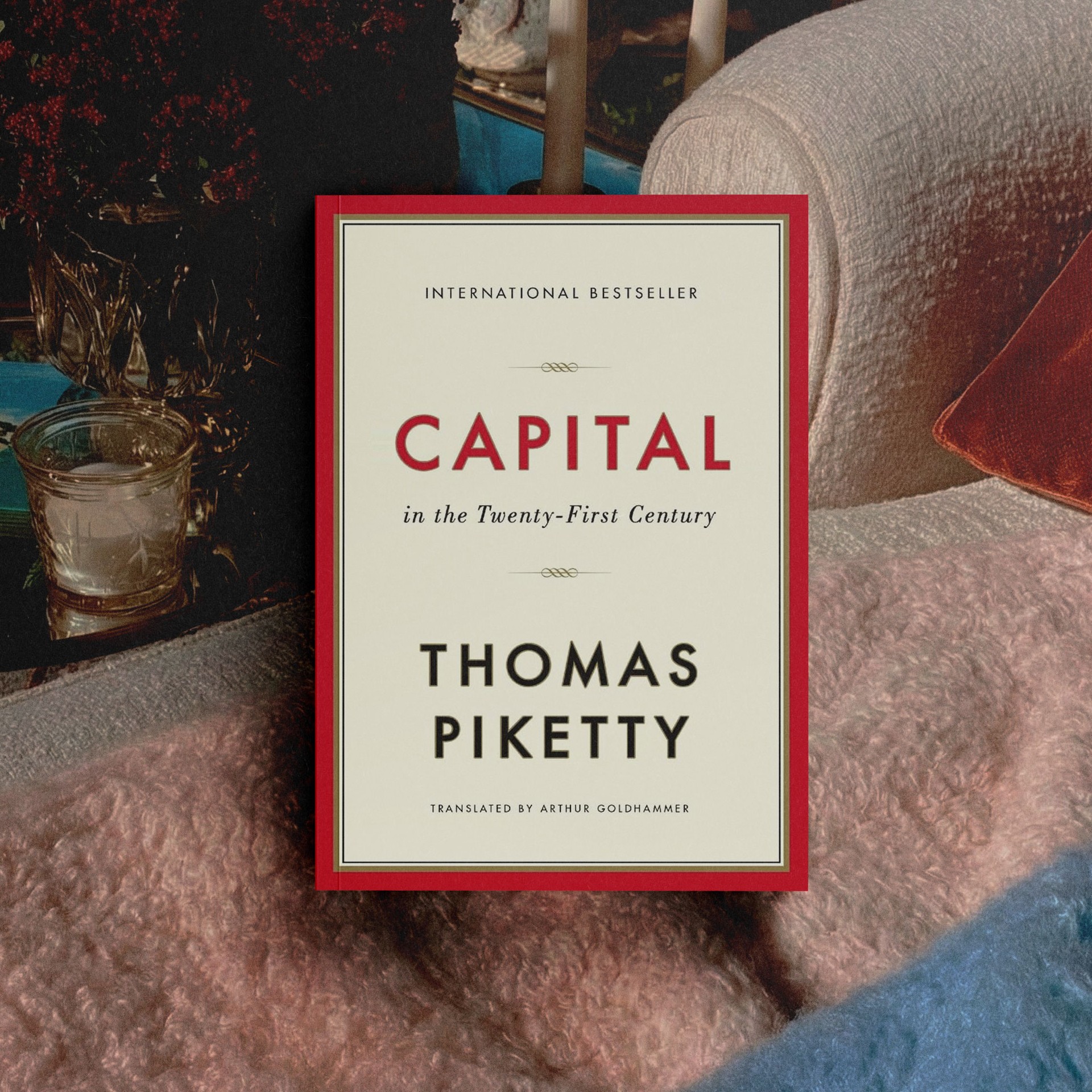
Capital in the Twenty-First Century (Belknap Press, 2014) This is the monumental work of economic history that defined the modern debate on inequality. Through an exhaustive analysis of tax records and data spanning centuries, French economist Thomas Piketty demonstrates that the return on capital (r) historically exceeds the rate of economic growth (g). He argues that without intervention, this dynamic (r>g) inevitably leads to a concentration of wealth that threatens democratic values, sparking a global conversation on wealth taxation and economic justice.
After more than 15 years of strong equity performance, the future for retirement investors is highly uncertain. The fundamental math of retirement means that the timing of stock market returns has an enormous impact on outcomes. Over the long-run, the growth of the economy and financial assets have an upward drift that benefits retirees provided they are able to invest meaningfully for the long-term.
Societies thrive when ordinary people are given access to ownership, not just income. Mortgages turned renters into homeowners. Index funds turned savers into shareholders. Yet for most Americans, retirement investing still arrives too late and with too little capital for compounding to do its work.
The result is a widening gap between those who live off capital and those who rely solely on labor. At Basic Capital, we believe this is not a law of nature but a solvable design problem. By pulling forward future savings and pairing long-term financing with low-cost, passive investing, we aim to give more people the chance to participate meaningfully in the growth of the economy.
America has built the most powerful wealth-generating system in history. Our work is about enabling more Americans to become long-term owners in that system and to share directly in the wealth it creates.